Function: Confocal
The Confocal function allows the acquisition of high-resolution confocal images, which is useful when dSTORM is not viable:
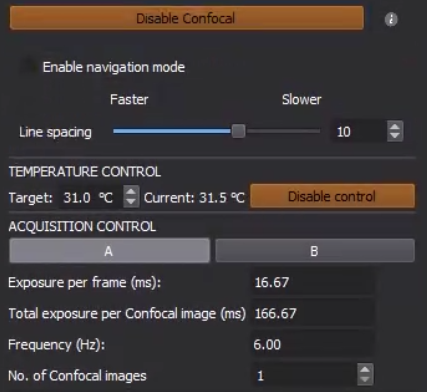
- Enable/Disable Confocal: enable/disable the confocal mode.
- Enable Navigation Mode: allow to quickly navigate the sample with minimal processing. The line-scan feature is disabled and therefore has no optical sectioning.
- Line Spacing (Faster or Slower): set the density of the "lines" (or patterns) projected onto the sample, which determines the number of frames acquired to reconstruct a confocal image.
- Exposure Per Frame (ms): set the exposure for each individual camera capture. This value will then be cast to a multiple of 16.66 ms, where the actual exposure is about 5.66 ms per frame. Multiple frames will be acquired to meet the total exposure requirement.
- Total Exposure Per Confocal Image (ms): set the total exposure for capturing each individual confocal image. Normally this value gets automatically updated as Exposure Per Frame * Line Spacing.
- Frequency (Hz): set the capture frequency per confocal image. Normally this value gets automatically updated as 1000 / Total Exposure Per Confocal Image.
- No. Of Confocal Image: set the number of confocal images to acquire.
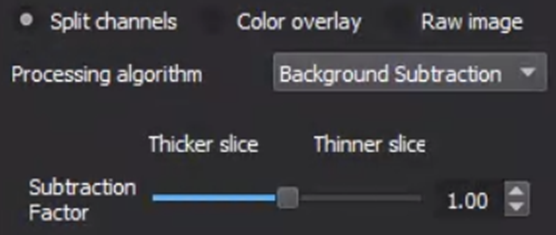
- Processing Algorithm: set the processing algorithm for reconstructing the confocal image to either Background Subtraction (default and recommended) or Standard Deviation.
- Subtraction Factor (Thicker Slice or Thinner Slice): set the subtraction factor for reconstructing the confocal image.
Instructions:
- Click on Enable Confocal to engage the DMD.
- Check Enable Navigation Mode and tune the laser power such that the sample is visible.
- Set the desired acquisition settings, including Line Spacing, Exposure Per Frame, and No. Of Confocal Images.
- Uncheck Enable Navigation Mode and Click on Acquire to start the acquisition.
- In Analyze, rerun the confocal processing with a different subtraction factor if needed:
Discussions:
- The ONI confocal is not a standard pinhole-based confocal but a DMD-based confocal.
- In confocal, the illumination intensity is lower due to the nature of structured illumination and mirror absorption. Lasers are switched off when engaging/disengaging confocal to avoid bleaching. Normally the laser power needs to be 3~4 times higher.
- In the navigation mode, even though the sample is fully illuminated, the intensity is not the same as that of normal illumination due to mirror absorption.
- Higher line spacing means more frames (or longer acquisition) and better resolution. It is recommended to be at least 7.
- The recommended subtraction factor is between 0.98 and 1.02.